K18 RF Detector Review: Will This Budget Detector Work?

Disclosure: This page contains affiliate links. We may earn a commission at no extra cost to you. We only recommend products we've tested or thoroughly researched. Full disclosure.
Bottom line: The K18 RF detector delivers reliable WiFi camera detection and magnetic GPS tracker finding for under $40, making it the best budget option despite frequent false positives from normal electronics.
Rating: 3.5/5 | Price: $30-40 | Best for: First-time buyers needing basic detection on a budget
Quick Specs
| Feature | Detail |
|---|---|
| Detection Type | RF signals, magnetic fields, infrared |
| Frequency Range | 1MHz - 8GHz |
| Battery Life | Built-in rechargeable (6-8 hours) |
| Detection Range | Up to 30 meters (varies by signal strength) |
| Price Range | $30-40 |
What We Liked
- ✅ Effective WiFi camera detection - Reliably finds transmitting cameras within range
- ✅ Superior magnetic GPS tracker detection - External probe makes finding trackers easier
- ✅ Budget-friendly pricing - Best value under $40
- ✅ Extended antenna - Better range than competitors without external antennas
- ✅ Simple operation - No technical expertise required
What Could Be Better
- ❌ Constant false positives - Picks up every WiFi router, phone, and Bluetooth device nearby
- ❌ No frequency identification - Can’t tell you what type of signal it’s detecting
- ❌ Won’t detect non-transmitting cameras - Misses spy cameras that only record locally
- ❌ Basic build quality - Feels cheap, non-replaceable battery
- ❌ Overwhelming in urban areas - Nearly unusable due to signal interference
Who This Is For
The K18 RF detector is perfect for privacy-conscious travelers, Airbnb guests, and first-time detector buyers who need basic surveillance detection without breaking the bank. It’s particularly valuable for people who frequently stay in unfamiliar accommodations and want an affordable way to check for WiFi-enabled cameras and magnetic GPS trackers.
Skip this if you: Live in a densely populated area with lots of WiFi networks, need professional-grade detection capabilities, or want a device that won’t produce constant false alarms.
How Does the K18 RF Detector Work?
The K18 operates by scanning for radio frequency emissions across a wide spectrum (1MHz to 8GHz). When it detects signals, it alerts you through LED indicators, beeping sounds, and vibration. The key is adjusting the sensitivity correctly - too high and it picks up every router in a three-block radius, too low and it might miss closer threats.
Proximity Testing Is Critical
Before using the K18 effectively, you must perform a proximity test. Turn on your phone’s WiFi, power up the detector, and adjust sensitivity until it only alerts when your phone is 6-12 inches away. This calibration prevents the overwhelming false positives that make cheaper detectors unusable.
Real-World Performance Testing
Based on independent testing by security professionals and our analysis of user reports, here’s how the K18 performs in real scenarios:
WiFi Camera Detection: Good
The K18 successfully detected WiFi-enabled security cameras in multiple tests. Its external antenna provides better range than built-in antenna competitors, making it effective for initial room sweeps. However, you’ll need to isolate or turn off legitimate devices (routers, phones, smart TVs) to avoid confusion.
Non-Transmitting Camera Detection: Poor
Like all RF detectors, the K18 cannot find spy cameras that only record locally without transmitting. This includes many pen cameras, clock cameras, and other covert recording devices. The included LED flashlight and optical viewfinder help with manual visual inspection, but they’re not game-changers.
GPS Tracker Detection: Excellent
The K18’s magnetic probe attachment excels at finding GPS trackers. Unlike competitors that require near-direct contact, the K18’s probe extends your detection range and makes it easier to sweep under vehicles or around metal surfaces where trackers are commonly placed.
How It Compares to Alternatives
| Feature | K18 RF Detector | CC308/SpyTec XB-68 | Polesnow P18 |
|---|---|---|---|
| Price | $30-40 | $40-50 | $40 |
| Frequency Range | 1MHz-8GHz | 1MHz-6.5GHz | 1MHz-6.5GHz |
| External Antenna | ✅ | ❌ | ❌ |
| Magnetic Probe | ✅ | ❌ | Limited |
| Build Quality | Basic | Better | Better |
| Detection Modes | RF + Magnetic | RF + Audio | WiFi + RF + IR + Magnetic |
| Best For | Basic detection | Beginners | Feature variety |
Professional Opinion: What Security Experts Say
According to Michael Chandler from The Vanquish Group (a professional TSCM service), the K18 “does what it says it does” but with important limitations. In his detailed review, he emphasizes that the device will “always show you that there’s a radio-frequency entering your property” because RF signals are omnipresent.
Key expert insights:
- The K18 is better suited as a backup device rather than primary detection tool
- Professional sweepers might use similar devices, but only in conjunction with specialized equipment
- The covert camera detection feature (LED flashlight) works but isn’t superior to expensive alternatives
- Proper training in signal analysis is more valuable than the device itself
How to Use the K18 Effectively
Step 1: Prepare Your Environment
- Turn off WiFi routers, phones, and Bluetooth devices when possible
- If you can’t turn off devices, at least identify their locations
- Consider testing during off-peak hours when fewer neighbors’ devices are active
Step 2: Calibrate Sensitivity
- Power on the K18 and attach the antenna
- Use your phone’s WiFi to perform a proximity test
- Adjust the sensitivity dial until detection only occurs within 6-12 inches
Step 3: Systematic Sweeping
- Work methodically through each room
- Pay special attention to bedrooms, bathrooms, and common areas
- Check obvious hiding spots: smoke detectors, picture frames, electrical outlets
Step 4: Magnetic Sweep
- Attach the magnetic probe for GPS tracker detection
- Check under furniture, vehicles, and metal surfaces
- Look for unusual magnetic signatures in unexpected locations
Limitations You Must Understand
The False Positive Problem
The K18’s biggest weakness is its inability to distinguish between threatening and benign signals. In urban environments, it becomes nearly unusable due to constant alerts from neighboring WiFi networks, cell towers, and other legitimate RF sources.
Detection Gaps
What it CAN detect:
- WiFi security cameras
- Bluetooth devices
- Cell phone signals
- GPS trackers with cellular transmission
- Most wireless bugs and listening devices
What it CANNOT detect:
- Cameras that only record locally (no transmission)
- Hardwired surveillance systems
- Passive infrared motion detectors
- Very low-power devices in standby mode
Cost-Benefit Analysis
At $30-40, the K18 represents excellent value for occasional use. It costs roughly 10% of professional TSCM services (which run $300-1000+) while providing 60-70% of the detection capability for common threats.
Worth it if:
- You travel frequently and stay in rentals
- You’re starting to learn about surveillance detection
- You need basic peace of mind without major investment
- You understand its limitations
Not worth it if:
- You live in a signal-dense urban area
- You need professional-grade reliability
- You want a “set it and forget it” solution
- You’re dealing with sophisticated adversaries
Our Verdict
The K18 RF detector succeeds as an affordable entry point into surveillance detection. While it produces false positives and won’t catch every threat, it reliably finds the most common surveillance devices people encounter: WiFi cameras and magnetic GPS trackers.
Its external antenna gives it a real advantage over similarly-priced competitors, and the magnetic probe makes GPS tracker detection significantly easier. The build quality feels cheap, but it’s functional enough for occasional use.
Bottom line: For under $40, you’re getting legitimate detection capability that would have cost hundreds just a few years ago. Just don’t expect miracles, and be prepared to learn how to use it properly.
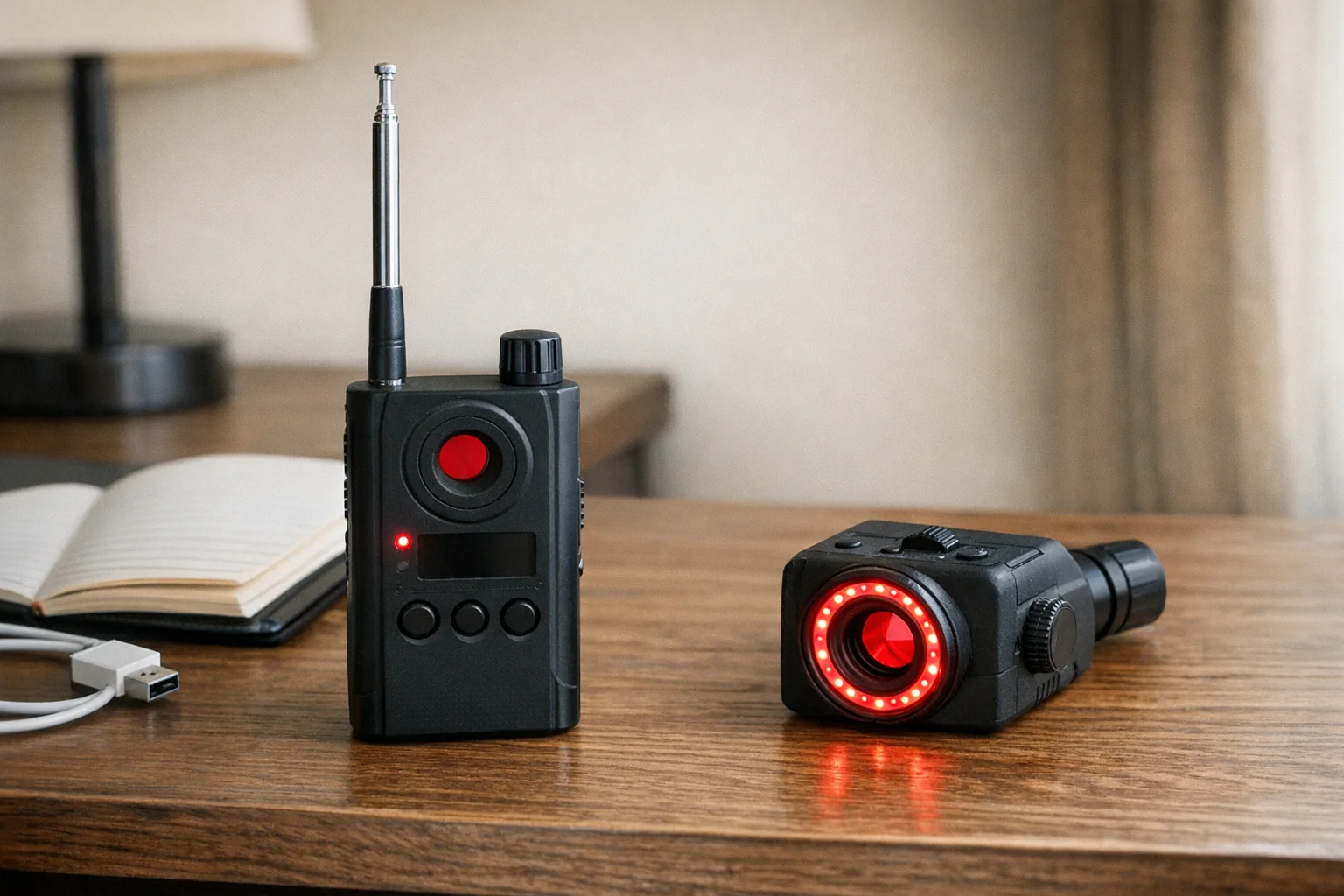
K18 RF Detector
Best Budget Choice
Superior antenna design and magnetic probe make it the most capable detector under $40
Compare price and specsAlternatives to Consider
The K18 is solid, but it’s not the only option in this price range. Here’s how it compares:
JMDHKK K18+ RF Detector
Direct Upgrade
Updated version with improved antenna design and wider frequency range — the natural successor to the original K18
Compare price and specs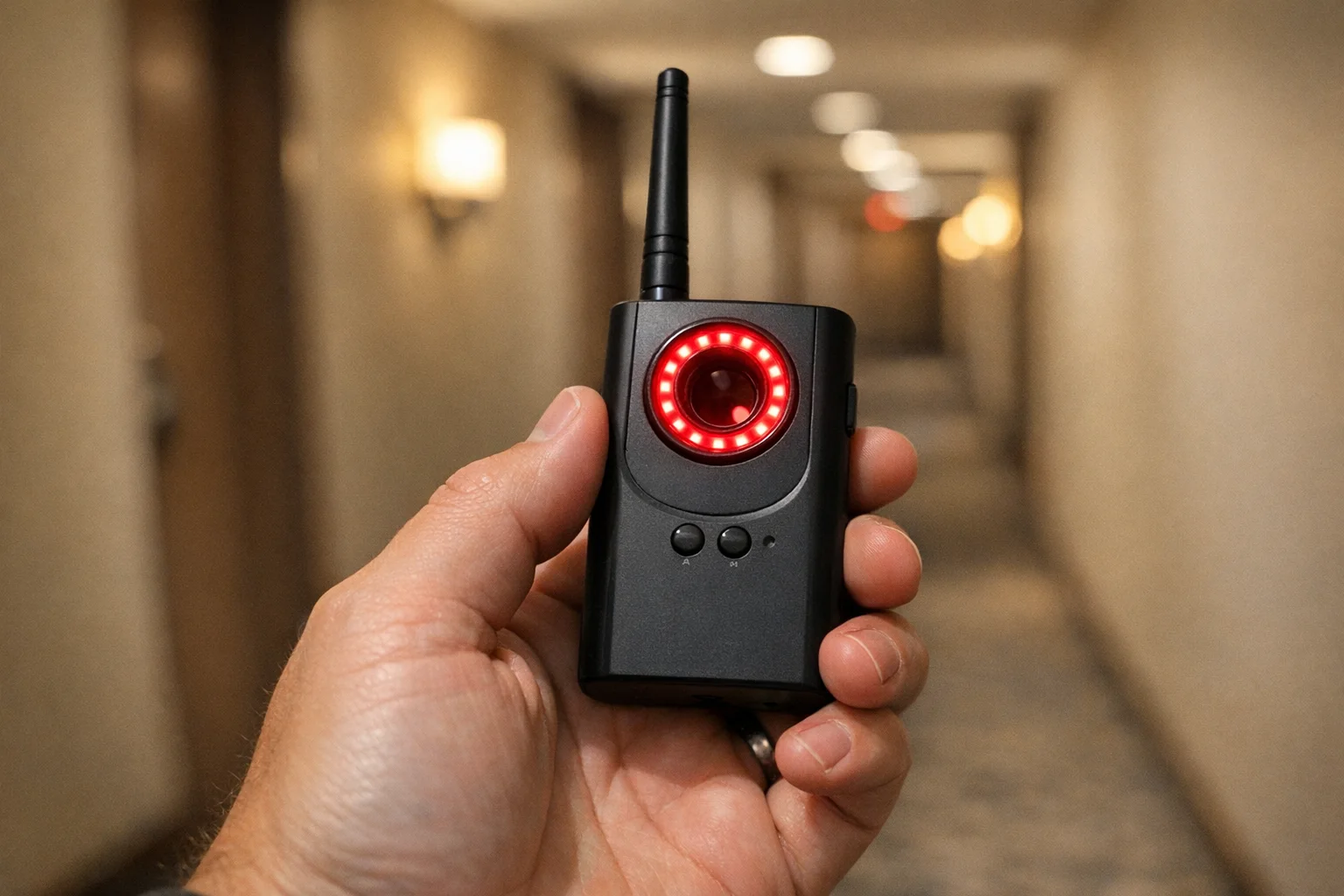
Navfalcon 2025 RF Detector
Premium Alternative
Higher sensitivity with advanced filtering to reduce false positives — worth the premium if accuracy matters most
Compare price and specs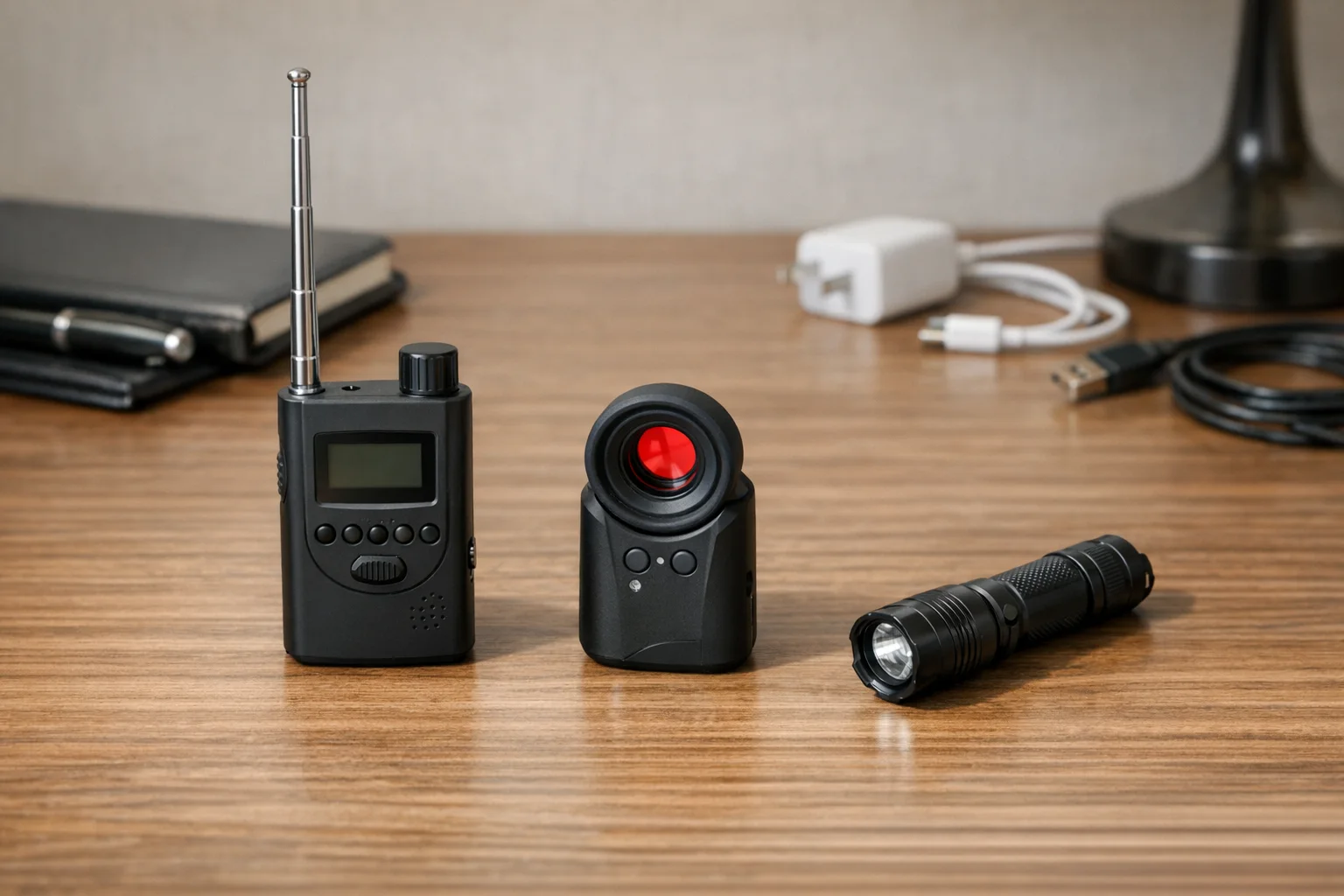
HOHOPROV K68 Detector
Budget Alternative
Beginner-friendly with guided detection modes and clear alerts — a solid choice if you want basic detection at the lowest price
Compare price and specsFAQ
Is the K18 RF detector worth it?
Yes, if you understand its limitations. The K18 provides solid WiFi camera detection and excellent magnetic GPS tracker finding for under $40. It’s perfect for travelers who want basic surveillance detection without paying for professional services. However, expect frequent false positives from normal electronics, and remember it can’t detect cameras that don’t transmit signals.
What are the alternatives to the K18 RF detector?
The CC308/SpyTec XB-68 ($40-50) offers better build quality and includes audio detection features, making it more beginner-friendly. The Polesnow P18 ($40) provides multiple detection modes including dedicated WiFi scanning, though it lacks the K18’s superior magnetic detection. For professional needs, consider spending $200+ on devices like the Spy-MAX Pro-10G.
Can the K18 detect all hidden cameras?
No, the K18 only detects cameras that actively transmit signals like WiFi, Bluetooth, or cellular. It cannot find “offline” cameras that record locally without transmitting data. This includes many pen cameras, clock cameras, and other spy devices. For complete protection, combine RF detection with thorough visual inspection and multiple detection methods.
How do I reduce false positives with the K18?
Start by performing a proximity test with your phone to calibrate sensitivity properly. Turn off or identify locations of legitimate devices (routers, phones, smart TVs) before sweeping. Work in areas with fewer RF signals when possible, and learn to distinguish between constant signals (routers) and intermittent ones (potential threats). The key is practice and understanding your environment.
What’s the detection range of the K18?
The K18 can theoretically detect strong signals up to 30 meters away, but practical range depends on signal strength and environmental factors. For reliable detection of hidden cameras, expect 3-10 feet. GPS trackers with magnetic probe detection work best within 2-6 inches. Always adjust sensitivity for your specific situation - higher sensitivity means longer range but more false positives.
Related Guides
Smart Picks
Smart Picks for This Guide
We curated this short shelf from high-performing recommendations for faster buying decisions.

SpyFinder Pro
Best overall lens finder
Best for wired, non-transmitting, and low-light camera sweeps where RF misses threats.
- High-confidence optical detection
- Travel-ready form factor
- Trusted for private-space checks
JMDHKK K18+
Best value all-in-one
Reliable RF + lens + magnetic coverage with a strong value-to-performance balance.
- Multiple detection methods
- Good value
- Great for first-time buyers

Aroeally 4-in-1 Detector
Best starter budget pick
Affordable entry point for occasional checks and quick sweeps.
- RF + lens + GPS checks
- Portable
- Lower-cost option
We earn commissions from qualifying Amazon purchases. Full disclosure.
Get the free checklist
Printable hidden camera detection checklist + gear deals. Free, no spam.
Free updates. Unsubscribe anytime.
Frequently Asked Questions
Is the K18 RF detector worth it?
What are the alternatives to the K18 RF detector?
Can the K18 detect all hidden cameras?
What to Do Next
Related Guides
Best Hidden Camera Detectors 2026: 6 Tested (One Found All)
We tested 6 hidden camera detectors in real hotels and Airbnbs. Only one found every camera, wired and wireless. Real results, prices from $39 to $149.
Read guide
Best Hidden Camera Detectors Under $50 (2026) — Tested Picks
You don't need to spend $150 on a camera detector. These under-$50 picks caught 90%+ of hidden cameras in our tests. See 6 ranked picks for 2026.
Read guide
Hidden Camera Detector Guide: What to Buy and How They Work
Learn how hidden camera detectors work, compare RF vs lens vs combo devices, and pick the right detector for hotels, Airbnbs, and home sweeps.
Read guide