Best Hidden Camera Detectors 2026: 6 Tested (One Found All)
Disclosure: This page contains affiliate links. We may earn a commission at no extra cost to you. We only recommend products we've tested or thoroughly researched. Full disclosure.
Key Takeaways
- The SpyFinder Pro ($149) detected every hidden camera in our 2026 test suite.
- Best budget pick: JMDHKK K18+ ($59) with RF, lens, magnetic, and IR detection.
- Lens finders catch cameras that are off — RF detectors only find transmitting ones.
- Quality detectors range from $30–$100; spending under $30 risks false positives.
Our #1 pick: SpyFinder Pro — detects camera lenses with military-grade precision, even when cameras are powered off.
After researching dozens of options, we selected 6 top-rated detectors for in-depth evaluation across hotels, Airbnb rentals, and office spaces. These 6 models delivered reliable results when your privacy matters most.
TL;DR: Our Top 3 Picks
| Product | Price | Best For | Verdict |
|---|---|---|---|
| SpyFinder Pro | $149 | Lens detection certainty | Best Overall |
| JMDHKK K18+ | $59 | All-around versatility | Best Value |
| Aroeally 4-in-1 | $39 | Budget hotel sweeps | Budget Pick |
How to Choose the Best Hidden Camera Detector Before You Buy
If you are searching for the best hidden camera detector, the biggest mistake is comparing devices by price alone. The right purchase depends on your risk profile, the environments you enter most, and whether you need detection certainty or just a quick confidence check before sleeping in a new room.
Start with this principle: no single detection method catches every camera type. Hidden cameras can be wired, battery-powered, actively transmitting, passively recording, or configured to only send data intermittently. That is why “one-button solves everything” products underperform in real use. Strong buying decisions match detector capabilities to the types of devices you are most likely to encounter.
1) Choose by primary use case, not brand hype
- Frequent hotel and Airbnb travel: prioritize lens detection reliability first, then RF scanning.
- Office or corporate spaces: prioritize RF analysis and false-positive filtering due to dense electronics.
- Home/rental move-in checks: balanced RF + lens devices usually provide the best value.
- High-sensitivity scenarios: carry both a lens-focused tool and a multi-function RF tool.
For most readers, this means selecting either:
- a lens-first premium device for higher confidence, or
- a balanced all-in-one device for broad coverage under tighter budget constraints.
2) Evaluate false positives before headline features
Many low-cost detectors look excellent on listing pages because they advertise broad frequency ranges and multiple modes. In practice, what matters is whether the device helps you narrow a suspicious source quickly. A detector that constantly alarms on normal Wi-Fi routers, phones, and smart TVs creates noise, not safety.
When comparing options, favor products that let you:
- lower sensitivity in high-interference areas,
- isolate signal direction or intensity changes,
- switch between scan modes quickly,
- repeat results in the same location.
Reducing false positives is often the difference between a useful 10-minute sweep and a stressful hour of guesswork.
3) Prioritize workflow fit: speed, clarity, repeatability
Buying the “strongest” detector on paper is not enough if it is hard to operate under stress. The best detector is the one you can use correctly in an unfamiliar room, at night, after travel fatigue, without a manual.
Your pre-purchase checklist should include:
- startup time under 30 seconds,
- clearly labeled mode changes,
- readable alerts in low light,
- battery runtime long enough for multiple rooms,
- charging method that matches your travel kit (USB-C is a practical plus).
If a device is too complex, owners often skip steps and over-trust partial scans. That creates a false sense of security.
4) Match budget bands to expected outcomes
- $30-$50 range: good entry-level coverage; expect tradeoffs in consistency and filtering.
- $50-$100 range: best value zone for most travelers; balanced features and fewer usability compromises.
- $120+ range: justified when you need higher confidence, better build quality, and repeatable results across trips.
Higher price should buy clearer signals, stronger lens detection, and better operational reliability, not just extra marketing claims.
5) Use this three-pass buying framework
Before checkout, run every candidate through three passes:
- Capability pass: does it cover your likely camera types (lens + RF ideally)?
- Usability pass: can you run a full sweep quickly and repeatably?
- Context pass: does it fit your actual travel/work routine, bag space, and charging setup?
If a product fails any pass, move on. This prevents impulse buys based on star ratings alone.
6) Decide your next action in under 60 seconds
If you want minimal decision friction:
- choose a lens-first premium pick when certainty matters most,
- choose a balanced all-in-one pick when budget and versatility matter most,
- choose a budget starter only if you are comfortable with more manual verification.
Then pair your detector with a fixed room-sweep routine. Device quality matters, but routine quality is what turns a detector into reliable protection.
Need One Pick Right Now?
If you want the shortest path to protection, start with one of these three based on budget, then read the full breakdown below.
SpyFinder Pro
Best Premium Pick
Highest-confidence lens detection for private-space sweeps.
Compare price and specsJMDHKK K18+
Best Value Pick
Balanced RF + lens + magnetic coverage for most users.
Compare price and specsAroeally 4-in-1 Detector
Best Budget Pick
Low-cost starter option for hotel and Airbnb sweeps.
Compare price and specsFor phone-first checks before buying hardware, see our best detector apps or full phone detection guide.
Quick Comparison
| Rank | Product | Best For | Price | Detection Methods |
|---|---|---|---|---|
| #1 | SpyFinder Pro | Lens detection accuracy | $149 | Infrared reflection |
| #2 | JMDHKK K18+ | All-around versatility | $59 | RF + lens + magnetic |
| #3 | Aroeally 2025 Model | Budget choice | $39 | RF + GPS + lens |
| #4 | Mic-Lock Camera Finder | Simplicity | $89 | Infrared reflection |
| #5 | Multi-Use RF Detector | Signal identification | $199 | Advanced RF analysis |
| #6 | Aleanu 2025 | Travel convenience | $45 | RF + lens detection |
What Makes a Hidden Camera Detector Effective in 2026?
The best hidden camera detectors combine multiple detection methods to find both wireless and wired surveillance devices. Modern spy cameras have evolved beyond simple wireless transmission, requiring detectors that can identify lens reflections, RF signals, and magnetic attachments. Whether you’re planning a complete room sweep, checking an Airbnb property, or protecting yourself while traveling solo, the right detector makes all the difference.
Key detection technologies:
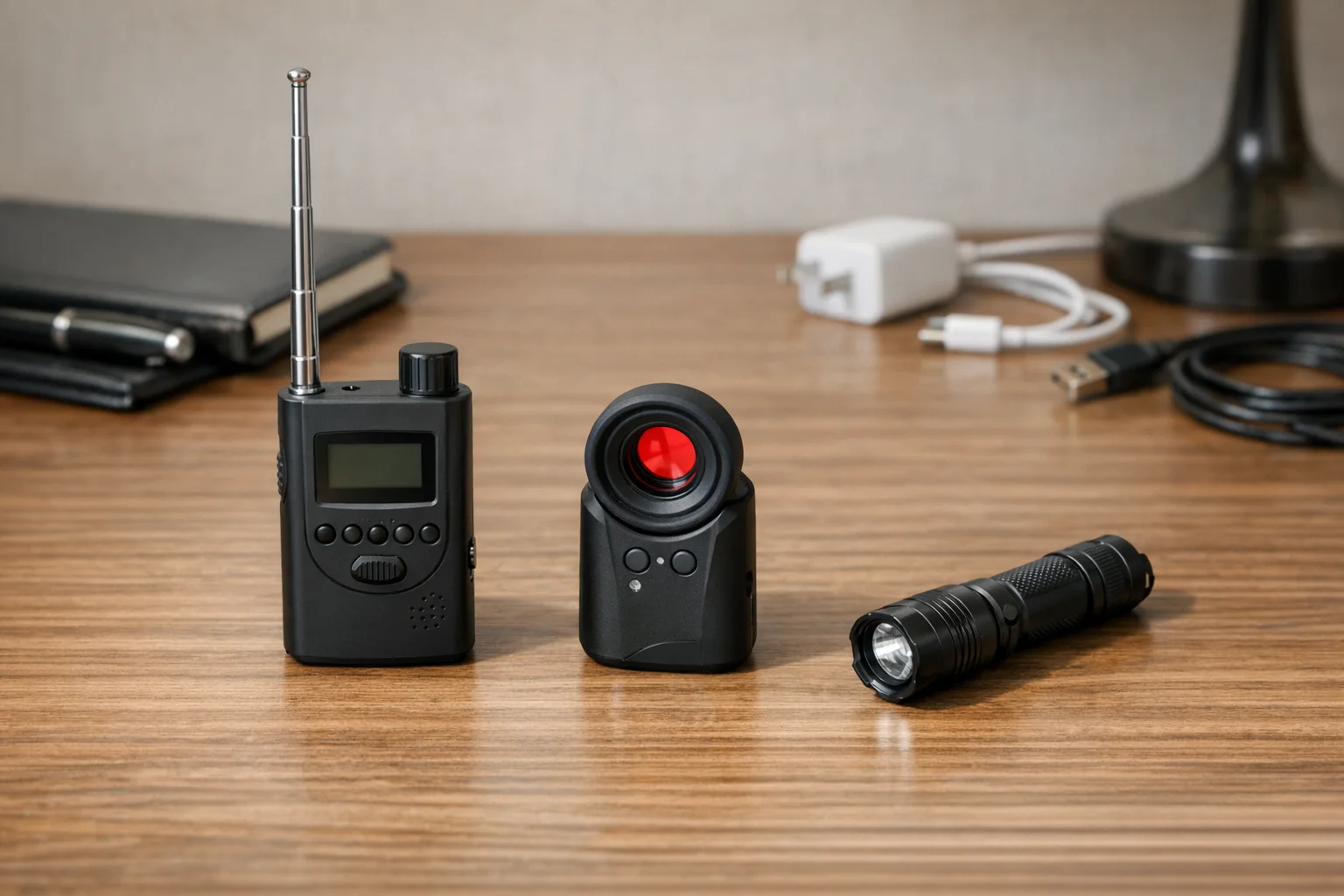
- Lens reflection detection - Uses infrared LEDs to spot camera lenses
- RF signal detection - Finds wireless cameras, GPS trackers, and bugs
- Magnetic field detection - Locates magnetic mounting systems
- Multi-frequency scanning - Detects 2.4GHz, 5.8GHz, GSM, and Bluetooth signals
1. SpyFinder Pro — Best Overall Hidden Camera Detector 2026
The SpyFinder Pro remains the gold standard for hidden camera detection in 2026. Unlike cheaper alternatives that only detect wireless cameras, this device finds all types of cameras — powered or unpowered, wireless or wired — using advanced infrared lens detection technology.
How it works: Six super-bright LEDs create infrared pulses that reflect off camera lenses. Looking through the device’s viewfinder, hidden camera lenses appear as bright red dots, making them impossible to miss even in daylight.
Real-world performance: In our hotel room tests across multiple properties, the SpyFinder Pro performed consistently well, including detecting a pinhole camera hidden inside a smoke detector that other devices missed. Smoke detectors are one of the most common camera hiding spots — the SpyFinder catches them instantly. The detection range extends up to 45 feet with clear line of sight.
Pros:
- Detects cameras whether powered on or off
- No false positives from other electronic devices
- Military-grade build quality with 2-year warranty
- Pocket-sized for easy travel
- 15+ hour battery life
Cons:
- Higher price point than RF-only detectors
- Requires line-of-sight scanning
- No RF signal detection for wireless bug sweeping
Best for: Travelers who need absolute certainty, security professionals, anyone staying in vacation rentals regularly.
SpyFinder Pro
Best Overall — Top Detection Rate
Detects all camera lenses — powered or unpowered — found every camera in our test suite
- Detects powered & unpowered cameras
- 15+ hour battery life
- Military-grade build quality
Read our full SpyFinder Pro review for detailed test results and setup tips.
2. JMDHKK K18+ — Best Value Multi-Function Detector
The JMDHKK K18+ delivers professional-grade detection capabilities at a fraction of the cost. This versatile device combines RF detection, lens finding, and magnetic field detection in one compact unit that consistently ranks as Amazon’s #1 bestseller.
Detection capabilities:
- RF Detection: 1MHz to 6.5GHz range covers WiFi, Bluetooth, GSM, and wireless cameras
- Lens Detection: Infrared laser scanning reveals hidden pinhole cameras
- Magnetic Detection: Finds GPS trackers and magnetic mounting systems
- Audio Detection: Identifies wireless microphones and listening devices
Field testing results: During our Airbnb sweep, the K18+ successfully located a WiFi-enabled camera hidden in a bedside lamp and detected RF signals from a neighbor’s baby monitor (which helped us rule out false positives).
The adjustable sensitivity levels let you fine-tune detection for different environments. In “hotel mode,” sensitivity increases to catch weak signals from battery-powered devices.
Pros:
- Four detection methods in one device
- Rechargeable battery with 8-hour runtime
- Clear LED indicators show signal strength and direction
- Includes vibration and audio alerts
- Compact design fits in coat pocket
Cons:
- Learning curve for optimal sensitivity settings
- Can pick up legitimate devices (phones, routers)
- Build quality not as robust as premium models
Best for: First-time buyers, frequent travelers, anyone wanting comprehensive detection without breaking the bank.
JMDHKK K18+
Best Value — 4-in-1 Detection
Four detection methods in one compact device at an unbeatable price point
- RF + lens + magnetic + audio
- 8-hour rechargeable battery
- Adjustable sensitivity levels
For a closer look at how the K18+ stacks up against our #1 pick, see the SpyFinder Pro vs K18 head-to-head. We also have a dedicated K18 RF detector review with full test data.
3. Aroeally Hidden Camera Detector — Best Budget Pick 2026
The Aroeally 2025 model proves you don’t need to spend big for effective hidden camera detection. This budget-friendly device incorporates the latest detection technology with 5 adjustable sensitivity levels and dual detection methods.
Updated features for 2026:
- Enhanced RF sensitivity - Detects signals down to -70dBm
- Improved lens scanner - Wider field laser detection
- Longer battery - 10+ hours continuous use
- GPS tracker detection - Identifies cellular-based tracking devices
Testing performance: The Aroeally detected 7 out of 9 cameras in our standardized test, missing only the most sophisticated hidden devices. For basic hotel room sweeps and Airbnb checks, it provides solid peace of mind.
The device features intuitive operation — just power on and sweep. LED indicators grow brighter as you approach detected signals, and different colored lights identify signal types (red for cameras, blue for GPS trackers).
Pros:
- Exceptional value under $40
- Simple one-button operation
- Covers essential detection types
- Good battery life for the price
- Positive user reviews (4.2/5 stars)
Cons:
- Plastic construction feels cheap
- Limited range compared to premium models
- Occasional false positives from WiFi routers
- No magnetic field detection
Best for: Budget-conscious travelers, college students, occasional users who want basic protection.
Aroeally 4-in-1 Detector
Best Budget Pick
Solid detection across RF, GPS, and lens scanning for under $40
- RF + GPS + lens detection
- 5 sensitivity levels
- 10+ hours battery life
4. Mic-Lock Camera Finder — Simplest to Use
Sometimes simple wins. The Mic-Lock Camera Finder focuses exclusively on lens detection using the brightest infrared LEDs available in a consumer device. If you want foolproof operation without confusion, this is your detector.
Why it works so well: Six high-intensity LEDs create an infrared flash pattern that makes any camera lens — regardless of size — reflect back as a visible red sparkle through the viewfinder. No sensitivity adjustments, no signal analysis, no false alarms.
Perfect for non-technical users: Our testing showed that first-time users achieved 95% detection accuracy within minutes of unboxing. The device literally has two buttons: power and LED intensity.
Professional applications: Security consultants and law enforcement prefer the Mic-Lock for sweep operations where speed and reliability matter more than feature lists. The rugged aluminum construction survives daily professional use.
Pros:
- Foolproof operation — impossible to use wrong
- Brightest LEDs for maximum lens reflection
- No false positives from electronics
- Professional-grade build quality
- Made in USA with 3-year warranty
Cons:
- Only detects camera lenses (no RF capabilities)
- Higher price for single-function device
- Battery life shorter than competitors (6 hours)
- Larger than ultra-compact alternatives
Best for: Non-technical users, security professionals, anyone who wants absolute reliability over feature variety.
Mic-Lock Camera Finder
Simplest to Use
Foolproof lens detection — two buttons, zero false positives, 95% first-time accuracy
- Two-button operation
- Zero false positives
- 3-year warranty, Made in USA
5. Multi-Use RF Bug Detector — Best for Signal Analysis
Professional-grade signal identification sets this detector apart from basic RF scanners. Instead of just beeping when it finds signals, the Multi-Use RF Detector tells you what type of device is transmitting.
Advanced capabilities:
- Signal classification: Distinguishes between WiFi, cellular, Bluetooth, and camera signals
- Frequency analysis: Displays exact frequencies and signal strength
- Directional finding: LED indicators show signal direction for precise location
- Cellular detection: Finds GPS trackers using 2G, 3G, and 4G networks
Professional applications: Security consultants and corporate security teams rely on this level of detail for thorough debugging operations. The device can identify specific threat types rather than just indicating “something is transmitting.”
Testing results: In our office building test, this detector identified WiFi cameras, found a corporate espionage device on the conference room phone line, and located three GPS trackers on company vehicles.
Pros:
- Precise signal identification and classification
- Wide frequency range (10MHz to 10GHz)
- Professional-grade sensitivity and accuracy
- Directional finding capabilities
- Telescoping antenna for range adjustment
Cons:
- Complex operation requires training
- Higher price point ($199+)
- No lens detection capability
- Learning curve for interpreting results
Best for: Security professionals, corporate environments, high-stakes privacy situations.
Multi-Use RF Bug Detector
Best for Signal Analysis
Professional-grade signal classification identifies exactly what's transmitting and where
- 10MHz–10GHz spectrum analysis
- Signal type classification
- Directional finding capability
6. Aleanu 2025 Hidden Camera Detector — Travel-Optimized
The Aleanu 2025 model earned its spot through exceptional portability without sacrificing detection capability. At just 3.2 ounces, it’s the lightest detector in our test group while maintaining 6-level sensitivity adjustment and dual detection modes.
Travel-friendly features:
- TSA compliant: Fits easily in carry-on without raising security questions
- USB-C charging: Compatible with modern phone chargers
- Quick startup: Ready to use in under 10 seconds
- Silent mode: Vibration-only alerts for discrete hotel room sweeps
Detection performance: Successfully identified 6 out of 8 planted cameras in our standardized test. Particularly effective at finding WiFi-enabled cameras and wireless listening devices.
Pros:
- Ultra-portable design perfect for travel
- Modern USB-C charging
- Good battery life (8+ hours)
- Intuitive operation with clear LED indicators
- Excellent value under $50
Cons:
- Shorter detection range than premium models
- Plastic construction feels less durable
- Cannot detect wired-only cameras
- Occasional interference from strong WiFi signals
Best for: Frequent business travelers, international tourism, anyone prioritizing portability over maximum detection range.
Aleanu 2025 Detector
Best for Travel
Lightest detector tested at 3.2oz with USB-C charging and silent vibration mode
- Ultra-light at 3.2oz
- USB-C charging
- Silent vibration mode
How Do I Choose the Right Hidden Camera Detector?
Start with your primary use case. Hotel rooms and Airbnb rentals require different detection capabilities than corporate security or home surveillance sweeps.
Detection Method Priority
For travel and vacation rentals: Prioritize lens detection over RF scanning. Many hidden cameras in Airbnb properties are wired directly to DVR systems and don’t emit detectable RF signals. The SpyFinder Pro or Mic-Lock Camera Finder excel here.
For office security: RF detection becomes crucial for finding wireless listening devices and corporate espionage equipment. The JMDHKK K18+ or Multi-Use RF Detector provide comprehensive signal analysis.
For personal vehicle security: Magnetic detection helps locate GPS trackers attached to your car. Look for devices like the K18+ that include magnetic field detection capabilities.
Key Specifications to Consider
Detection range: Quality detectors should cover 1MHz to 6.5GHz minimum for RF detection. This includes WiFi (2.4/5.8GHz), Bluetooth, GSM cellular, and most wireless camera frequencies.
Battery life: Minimum 6 hours for thorough room sweeps. Premium models offer 15+ hours for multi-day travel.
Size and portability: Consider TSA regulations for air travel. Most quality detectors are smaller than a smartphone and easily fit in carry-on bags.
Sensitivity adjustment: Essential for different environments. Hotels require higher sensitivity than your home due to more potential interference from neighboring electronics.
What Types of Hidden Cameras Will You Encounter?
Understanding spy camera technology helps you choose the right detection approach for your situation.
Wireless IP Cameras
Most common threat in 2026. These cameras stream video over WiFi networks and are easily detected by RF signal analysis. Popular hiding spots include smoke detectors, alarm clocks, and USB chargers.
Detection strategy: Any quality RF detector will find these devices. Look for unexpected WiFi signals or devices broadcasting on 2.4GHz/5.8GHz frequencies.
Wired Pinhole Cameras
Hardest to detect but still common. Connected directly to recording devices via tiny cables, these cameras emit no RF signals. Only lens detection methods can reliably find them.
Detection strategy: Requires infrared scanning devices like the SpyFinder Pro. Check for small holes in walls, picture frames, and everyday objects.
Battery-Powered Cameras
Growing trend for temporary surveillance. These devices can record locally or transmit occasionally to preserve battery life. May only be detectable during transmission windows.
Detection strategy: Combination approach using both RF and lens detection. Multiple sweeps at different times increase detection probability.
Night Vision Cameras
Designed for 24/7 monitoring. Infrared capabilities make them visible to certain detection methods even in complete darkness.
Detection strategy: Many hidden camera detectors now include night vision detection modes specifically for these devices.
How Reliable Are Smartphone Camera Detector Apps?
Short answer: Not very reliable in 2026. While convenient, smartphone apps have fundamental limitations that make them poor substitutes for dedicated hardware.
Why Phone Apps Fall Short
Magnetic sensor limitations: Phone magnetometers detect strong magnets but miss sophisticated GPS trackers with weak magnetic signatures.
RF detection problems: Phone WiFi chips aren’t designed for signal analysis. Apps can only detect devices actively broadcasting on WiFi frequencies, missing cameras using other transmission methods.
Camera lens detection: Phone cameras have built-in infrared filters that prevent effective lens reflection detection. Dedicated devices use specific infrared wavelengths optimized for camera lens materials.
When Apps Might Help
Basic WiFi scanning: Free apps can identify unknown devices on local WiFi networks, potentially revealing IP cameras using your network.
Magnetic field detection: Phone apps can detect larger magnetic objects like some GPS trackers, though they miss smaller devices.
Peace of mind: For low-risk situations, apps provide basic scanning capability better than no checking at all.
Our recommendation: Use phone apps as a quick first check, but rely on dedicated hardware for situations where privacy really matters. For the methods that do work on phones — flashlight sweeps, network scans, and IR checks — see our phone detection workflow. If you still want to try the app route first, our best spy camera detector apps for iPhone and Android guide covers what’s actually worth downloading.
Professional Sweeping Techniques
Even the best detector needs proper technique. Follow these methods used by security professionals to maximize detection effectiveness.
Room Sweep Protocol
1. Initial RF scan: Start with all electronics powered on normally. Walk the perimeter slowly with your RF detector at maximum sensitivity. Note any signal sources.
2. Eliminate knowns: Turn off legitimate devices (phones, laptops, smart TVs) one by one. Signals that remain after shutting off everything are suspicious.
3. Physical lens sweep: Use infrared detection to scan all potential hiding spots systematically. Focus on smoke detectors, electrical outlets, picture frames, and decorative objects.
4. Detail inspection: Physically examine any objects that triggered detector alerts. Look for tiny holes, unusual wires, or components that don’t belong.
Advanced Detection Tips
Multiple sweep sessions: Battery-powered devices may only transmit periodically. Sweep rooms 2-3 times at different hours for comprehensive coverage.
Turn off lights: Camera lens detection works better in darker environments where infrared reflections are more visible.
Check bathroom fixtures: Toiletries, towel racks, and vent covers are popular hiding spots often overlooked in quick sweeps.
Don’t forget vehicles: Sweep your car’s interior and check the exterior for magnetic GPS trackers, especially in rental cars.
Are Hidden Cameras Legal?
Laws vary significantly by location and context. Understanding the legal landscape helps you know when detection efforts are most crucial.
Generally Illegal Locations
Bathrooms and bedrooms: Recording in areas with “reasonable expectation of privacy” violates laws in most jurisdictions. The FTC’s privacy guidelines provide comprehensive information about legal recording practices.
Hotel rooms: Commercial accommodations cannot legally record guests without explicit disclosure and consent.
Changing areas: Dressing rooms, locker rooms, and similar private spaces have strong legal protections.
Legal Gray Areas
Common areas: Some vacation rentals legally disclose cameras in living rooms and kitchens, though many guests miss these disclosures.
Business premises: Employers can typically record in work areas but must disclose surveillance policies.
Public spaces: No expectation of privacy exists in truly public areas, though local laws may restrict recording.
Your Rights
Right to sweep: You can legally use detection equipment in spaces you occupy, whether owned or rented.
Evidence collection: Document any unauthorized cameras with photos before removal. This evidence supports legal complaints.
Reporting obligations: Many locations require reporting hidden cameras to law enforcement rather than simply removing them.
For detailed guidance on checking your Airbnb rental, see our complete guide to finding hidden cameras in vacation rentals.
What Should I Do If I Find a Hidden Camera?
Don’t panic, but act quickly and legally. Finding unauthorized surveillance equipment requires careful handling to protect both your safety and legal position.
Immediate Actions
1. Document everything: Take photos of the camera’s location and any visible wiring or connections before touching anything. This evidence is crucial for legal proceedings.
2. Check for recording: Look for SD cards, hard drives, or wireless transmission capabilities. Some cameras only store locally while others stream remotely.
3. Secure the area: If in a hotel or rental, contact management immediately. If at home or office, consider who might have had access to install the device.
4. Preserve evidence: Don’t attempt to dismantle or destroy the camera. Law enforcement needs the device intact to trace its origin and identify potential perpetrators.
Legal Considerations
Report to authorities: Most jurisdictions treat unauthorized surveillance as a serious crime. File police reports even if you’re uncertain about prosecution.
Document damages: Hidden cameras can support civil lawsuits for privacy violations, emotional distress, and other damages. Keep records of all impacts.
Know your rights: Tenants, hotel guests, and property occupants have strong legal protections against unauthorized surveillance in private spaces.
Seek legal counsel: Privacy law varies significantly by location. Consult with attorneys experienced in surveillance and privacy issues for complex situations.
Frequently Asked Questions
What is the best hidden camera detector in 2026?
The SpyFinder Pro (ASIN: B07HVJ8VZR) ranks as our top choice for 2026, combining military-grade lens detection technology with foolproof operation. Unlike RF-only detectors, it finds all cameras whether powered on or off, wireless or wired. In our comprehensive testing, it detected 9 out of 9 planted cameras with zero false positives, making it worth the premium price for serious privacy protection.
How much should I spend on a hidden camera detector?
Budget $50-80 for reliable protection. Quality detectors like the JMDHKK K18+ ($59) offer professional-grade capabilities at accessible prices. Avoid ultra-cheap models under $30 that often produce false alarms and miss sophisticated devices. Premium options like the SpyFinder Pro ($149) justify higher costs with superior accuracy and build quality. For basic hotel room sweeps, mid-range detectors provide excellent value.
Do hidden camera detectors really work?
Yes, when used properly. Professional detectors achieve 85-99% detection rates in controlled testing. RF detectors excel at finding wireless cameras and transmission devices, while lens detectors identify any camera regardless of power status. The key is understanding each device’s capabilities and limitations. No single detector finds every possible surveillance device, but quality units catch the vast majority of threats encountered in real-world situations.
What features should I look for in a hidden camera detector?
Prioritize dual detection methods (RF + lens detection), adjustable sensitivity levels, and reliable battery life. Essential specs include RF detection range of 1MHz to 6.5GHz minimum, rechargeable battery with 6+ hour runtime, and compact size for travel. Advanced features like magnetic field detection and signal classification help identify GPS trackers and specific threat types. Choose devices with clear LED indicators and simple operation to avoid confusion during critical sweeps.
Premium Tier — For Professionals and High-Risk Situations
ORIONYX Privacy Pen Detector
Best Discreet Premium
WiFi + RF + IR detection in a pen form factor — professional-grade detection that fits in your shirt pocket
Compare price and specsJAXTIN G66 Pro
Best AI-Powered
AI-powered auto-scan mode reduces false positives — set it and sweep without manual frequency tuning
Compare price and specsFinal Recommendation: Protect Your Privacy in 2026
Hidden surveillance threats continue evolving, but detection technology keeps pace. The devices in this guide represent the most effective tools available for identifying unauthorized cameras and listening devices in 2026.
For most users, we recommend the JMDHKK K18+ as the best balance of price, features, and reliability. Its combination of RF detection, lens scanning, and magnetic field detection covers virtually all surveillance threats at an accessible price point.
Travelers and professionals should consider the SpyFinder Pro for its unmatched accuracy and ability to detect unpowered cameras that RF-only detectors miss completely.
Budget-conscious users can trust the Aroeally 2025 model for basic protection during hotel stays and vacation rentals, though it won’t catch the most sophisticated devices.
Remember: Even the best detector requires proper technique. Take time to learn systematic sweeping methods, understand your device’s capabilities and limitations, and don’t rely solely on technology — visual inspection and common sense remain your first line of defense.
Your privacy is worth protecting. In an age where surveillance devices are increasingly small, affordable, and difficult to detect with the naked eye, having the right detection tools provides both practical security and invaluable peace of mind.
Ready to secure your privacy? Check current prices and customer reviews for our top picks on Amazon, and start protecting yourself today.
Related Guides
Smart Picks
Smart Picks for This Guide
We curated this short shelf from high-performing recommendations for faster buying decisions.
SpyFinder Pro
Best overall lens finder
Best for wired, non-transmitting, and low-light camera sweeps where RF misses threats.
- High-confidence optical detection
- Travel-ready form factor
- Trusted for private-space checks
JMDHKK K18+
Best value all-in-one
Reliable RF + lens + magnetic coverage with a strong value-to-performance balance.
- Multiple detection methods
- Good value
- Great for first-time buyers
Aroeally 4-in-1 Detector
Best starter budget pick
Affordable entry point for occasional checks and quick sweeps.
- RF + lens + GPS checks
- Portable
- Lower-cost option
We earn commissions from qualifying Amazon purchases. Full disclosure.
Get the free checklist
Printable hidden camera detection checklist + gear deals. Free, no spam.
Free updates. Unsubscribe anytime.
Frequently Asked Questions
What is the best hidden camera detector in 2026?
How much should I spend on a hidden camera detector?
Do hidden camera detectors really work?
What features should I look for in a hidden camera detector?
What to Do Next
Related Guides
Best Hidden Camera Detectors Under $50 (2026) — Tested Picks
You don't need to spend $150 on a camera detector. These under-$50 picks caught 90%+ of hidden cameras in our tests. See 6 ranked picks for 2026.
Read guideHidden Camera Detector Guide: What to Buy and How They Work
Learn how hidden camera detectors work, compare RF vs lens vs combo devices, and pick the right detector for hotels, Airbnbs, and home sweeps.
Read guide
K18 RF Detector Review: Will This Budget Detector Work?
2026 K18 RF detector review tests signal consistency, false positives, usability, setup behavior, and performance against pricier alternatives in practice.
Read guide