Are Hotel Room Cameras Legal? Guest Privacy Rights by State
Disclosure: This page contains affiliate links. We may earn a commission at no extra cost to you. We only recommend products we've tested or thoroughly researched. Full disclosure.
In plain language: no, it is generally not legal to have hidden cameras in hotel rooms. Private guest spaces like bedrooms and bathrooms are protected by privacy and voyeurism laws in most jurisdictions. Cameras are typically permitted only in public-facing hotel areas (for example, lobbies and hallways) when used for security and disclosed appropriately.
If you are asking this question after spotting a suspicious device, treat it as a potential evidence event first and a legal research task second: document, leave the space, contact local law enforcement, then notify hotel management. State-level penalties and civil remedies differ, but the core privacy expectation inside a guest room is broadly recognized.
Disclaimer: This article provides general information about hidden camera laws and is not legal advice. Laws vary significantly by jurisdiction. Consult a licensed attorney for advice about your specific situation.
What You’ll Learn
- Legal boundaries for hotel surveillance cameras
- Your privacy rights as a hotel guest
- State-by-state variations in surveillance laws
- Actions to take if you discover illegal recording
- Professional detection tools to protect yourself
Is It Legal to Have Cameras in Hotel Rooms?
No, hidden cameras are illegal in hotel guest rooms, bathrooms, and other private areas. Hotels cannot legally install recording devices in spaces where guests have a reasonable expectation of privacy.
The legal foundation rests on privacy laws that recognize hotel rooms as temporary private residences. Once you check in, that room becomes your private space, protected under both criminal and civil privacy statutes. The Fourth Amendment provides constitutional protection against unreasonable searches, extending to hotel accommodations.
However, hotels can legally install visible security cameras in public areas like lobbies, hallways, elevators, and parking areas. These areas carry no reasonable expectation of privacy, and proper signage typically notifies guests of surveillance.
What Privacy Rights Do Hotel Guests Have?
Hotel guests have the same privacy rights as tenants in their temporary accommodations. This includes protection from unauthorized recording, surveillance, or entry without proper notice.
Your privacy rights include:
- Complete privacy in guest rooms and bathrooms
- Protection from unauthorized recording or surveillance
- Right to exclusive use of your rented space
- Protection from unlawful entry without emergency circumstances
State laws typically classify unauthorized hotel room recording as criminal voyeurism or invasion of privacy. Civil remedies may include damages for emotional distress, punitive awards, and attorney fees.
Our Top Detection Tools

JMDHKK Hidden Camera Detector
Best Overall
Professional-grade RF detection with lens finder
Compare price and specs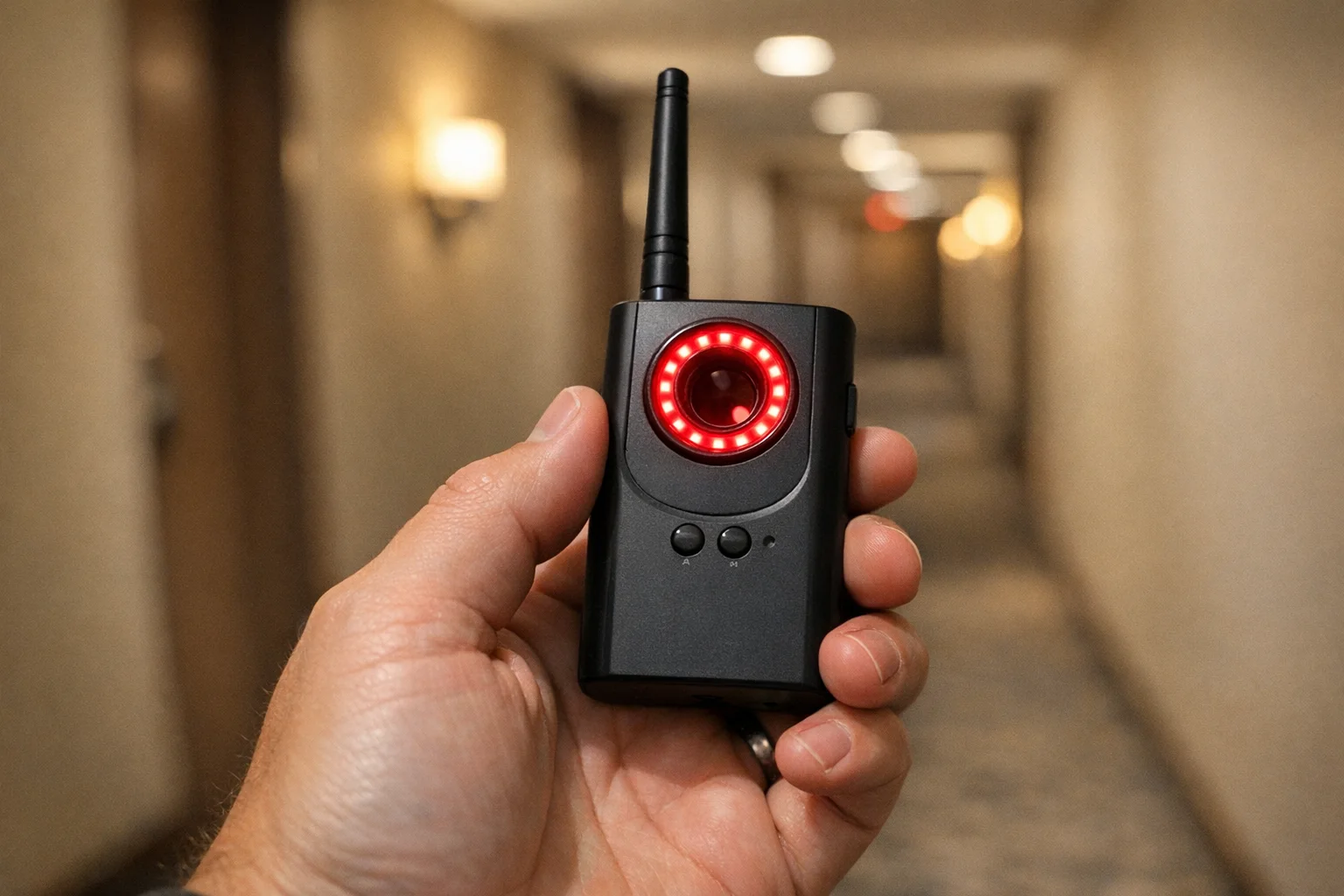
SpyHawk Pro-10G
Professional Grade
Military-grade detection for serious travelers
Compare price and specsHow Do State Laws Differ on Hotel Surveillance?
State privacy laws create varying penalties and protections for hotel surveillance violations. Understanding your location’s specific statutes helps determine your legal remedies.
California imposes the strictest penalties under Penal Code Section 647, classifying unauthorized recording as criminal voyeurism punishable by up to one year imprisonment and $2,000 fines. Civil remedies can reach $10,000 plus attorney fees.
New York treats hotel room recording as unlawful surveillance under Penal Law Section 250.45, with felony charges possible for repeat offenders. The state recognizes both criminal and civil causes of action.
Texas criminalizes improper visual recording under Penal Code Section 21.15, with enhanced penalties for commercial establishments like hotels. Violators face up to two years imprisonment.
Florida provides comprehensive protection under Florida Statute §810.145 (Video Voyeurism), with mandatory minimum fines and potential civil damages exceeding $10,000.
International travelers should research destination privacy laws. The European Union’s GDPR (General Data Protection Regulation) provides comprehensive personal data protections, while some countries have weaker enforcement mechanisms. Consult your destination’s tourism or legal authority for current privacy protections.
What Should You Do If You Find Hidden Cameras?
Immediately document the device, contact authorities, and preserve all evidence. Your response in the first few minutes determines your legal options and safety.
Follow this step-by-step protocol:
- Document the camera — Take multiple photos showing its location, size, and placement without touching the device
- Secure the scene — Don’t allow hotel staff to remove or tamper with evidence
- Contact police immediately — File a formal report for criminal investigation
- Notify hotel management — Create official documentation of the discovery
- Contact your attorney — Begin civil proceedings while evidence remains fresh
- Preserve all documentation — Keep photos, police reports, and hotel correspondence
Never attempt to remove or disable the camera yourself, as this could compromise criminal evidence or create safety risks if the device is connected to external monitoring.
Step-by-Step Legal Process
- Evidence Collection — Document everything with timestamped photos and written records
- Criminal Report — File police reports in both the hotel location and your home jurisdiction
- Civil Consultation — Meet with privacy attorneys to evaluate damages and legal options
- Hotel Notification — Formal written notice to hotel ownership and management
- Insurance Claims — Contact your travel insurance for covered expenses and damages
Who Is Liable for Illegal Hotel Surveillance?
Multiple parties may bear legal responsibility depending on who installed and operated the surveillance equipment. Liability typically extends beyond just the camera installer.
Hotel ownership and management face the highest liability exposure, as they control property access and have duty to protect guest privacy. Even if staff members acted independently, hotels may bear vicarious liability under respondeat superior doctrine.
Individual employees who install or operate hidden cameras face personal criminal liability and civil damages. Employment termination provides no protection from prosecution.
Third-party installers including maintenance contractors or previous guests who leave devices can be prosecuted for criminal voyeurism and civil invasion of privacy.
Technology companies that manufacture surveillance equipment specifically for illegal use may face products liability claims, though most legitimate security equipment manufacturers include proper use warnings.
Property management companies that oversee hotel operations can share liability if they failed to implement adequate privacy protection protocols or ignored guest complaints about suspected surveillance.
What Damages Can You Recover?
Legal remedies include both economic and non-economic damages, with punitive awards possible in cases involving intentional privacy violations. Courts increasingly recognize significant harm from unauthorized intimate recording.
Economic damages cover direct costs including alternative accommodation expenses, travel disruption costs, medical treatment for emotional distress, and lost wages from travel delays.
Non-economic damages compensate for privacy invasion, emotional distress, loss of enjoyment, and reputational harm. Awards frequently range from $5,000 to $50,000 depending on the violation’s severity and duration.
Punitive damages punish particularly egregious conduct and deter future violations. California courts have awarded punitive damages exceeding $100,000 in commercial voyeurism cases.
Attorney fees may be recoverable under privacy statutes that include fee-shifting provisions, making legal action economically viable even for modest damages.
Criminal restitution can supplement civil awards when prosecutors pursue criminal charges against violators.
State-by-State Hotel Hidden Camera Laws (Quick Scan)
Laws change frequently. This table provides general guidance as of early 2026—always verify current statutes for your specific jurisdiction before taking legal action.
Before using the table, scan this summary first:
- Private guest rooms and bathrooms: generally protected from recording.
- Visible security cameras in public hotel areas: usually legal when properly disclosed.
- Hidden or undisclosed cameras in private spaces: typically criminal exposure plus civil liability.
| State | Voyeurism Statute | Hidden Camera Specific? | Penalty | Key Notes |
|---|---|---|---|---|
| California | Penal Code §647(j) | Yes | Misdemeanor/Felony | Two-party consent state, strict privacy protections, civil damages up to $10,000 |
| Florida | Fla. Stat. §810.145 | Yes | Felony (3rd degree) | Video voyeurism act covers hotels and rentals, mandatory minimum penalties |
| New York | Penal Law §250.45 | Yes | Class E Felony | Unlawful surveillance statute covers all private spaces, repeat offenders face enhanced penalties |
| Texas | Penal Code §21.15 | Yes | State jail felony | Improper photography/visual recording, enhanced penalties for commercial establishments |
| Nevada | NRS §200.604 | Yes | Category D/E Felony | Strong protections in hotels given tourism economy, broad voyeurism coverage |
| Illinois | 720 ILCS 5/26-4 | Yes | Class 4 Felony | Eavesdropping and video recording statutes, comprehensive privacy protection |
| Pennsylvania | 18 Pa.C.S. §7507.1 | Yes | Misdemeanor/Felony | Invasion of privacy statute, felony classification for repeat violations |
| Georgia | O.C.G.A. §16-11-62 | Partial | Misdemeanor/Felony | Covers surveillance in private places, case-by-case felony determination |
| Ohio | ORC §2907.08 | Yes | Misdemeanor | Voyeurism statute covers hidden recording, can escalate to felony for repeat offenses |
| Colorado | C.R.S. §18-7-801 | Yes | Class 2 Misdemeanor | Criminal invasion of privacy, broader definition of protected private areas |
How to use this table:
- Voyeurism Statute: The primary law criminalizing hidden camera use in your state
- Hidden Camera Specific?: Whether the law explicitly addresses cameras or requires interpretation
- Penalty: Criminal classification and typical sentencing range
- Key Notes: Relevant details about enforcement, civil liability, and special circumstances
Additional research resources:
- Contact your state’s attorney general office for current statute information
- Consult a local privacy attorney for jurisdiction-specific advice
- Check your state’s legislative website for recent amendments
- Review case law in your jurisdiction for how courts interpret these statutes
Frequently Asked Questions
Are hidden cameras legal in hotel rooms?
Hidden cameras are illegal in hotel guest rooms, bathrooms, and other private areas where guests have a reasonable expectation of privacy. Hotels may use visible security cameras in public areas like lobbies and hallways with proper notification.
What should I do if I find a hidden camera in my hotel room?
Document the camera with photos, don’t touch or move it, contact hotel management immediately, file a police report, and consider legal action. Keep all evidence and documentation for potential criminal prosecution and civil litigation.
Can hotels legally record guests without consent?
Hotels cannot legally record guests in private areas without consent. Recording in private spaces violates privacy laws and may constitute criminal activity in most jurisdictions. Public area surveillance requires proper notification signage.
What are the penalties for installing hidden cameras in hotels?
Penalties can include criminal charges for invasion of privacy, voyeurism, or unlawful surveillance, civil liability, fines up to $10,000, and potential jail time depending on jurisdiction. Some states impose felony charges for repeat violations.
How can I protect myself from hidden cameras in hotels?
Perform a thorough room sweep, use a camera detector device, check for unusual objects or tiny holes, look for blinking lights in darkness, and request a different room if you find anything suspicious. Consider bringing professional detection equipment for high-risk travel.
What to Do Next
Understanding your legal rights provides the foundation for protecting your privacy during hotel stays. While hidden camera laws strongly favor guest privacy, proactive detection remains your best protection.
Immediate actions to take:
- Research privacy laws for your travel destinations
- Invest in professional camera detection equipment
- Learn proper room inspection techniques
- Document any suspicious findings immediately
Always remember that privacy violations in hotels constitute serious legal matters with both criminal and civil consequences. When in doubt, trust your instincts and seek professional legal advice. For jurisdiction-specific privacy law information, consult Nolo.com’s privacy law guide or speak with a privacy attorney.
If you want a concrete enforcement-era case study to pair with these statutes, read our BBC hotel spycam investigation breakdown, then run the 5-minute hotel room sweep protocol before every check-in.
Related Guides
Smart Picks
Smart Picks for This Guide
We curated this short shelf from high-performing recommendations for faster buying decisions.
SpyFinder Pro
Best overall lens finder
Best for wired, non-transmitting, and low-light camera sweeps where RF misses threats.
- High-confidence optical detection
- Travel-ready form factor
- Trusted for private-space checks

JMDHKK K18+
Best value all-in-one
Reliable RF + lens + magnetic coverage with a strong value-to-performance balance.
- Multiple detection methods
- Good value
- Great for first-time buyers

Aroeally 4-in-1 Detector
Best starter budget pick
Affordable entry point for occasional checks and quick sweeps.
- RF + lens + GPS checks
- Portable
- Lower-cost option
We earn commissions from qualifying Amazon purchases. Full disclosure.
Get the free checklist
Printable hidden camera detection checklist + gear deals. Free, no spam.
Free updates. Unsubscribe anytime.
Frequently Asked Questions
Is it legal to have cameras in hotel rooms?
What should I do if I find a hidden camera in my hotel room?
Can hotels legally record guests without consent?
What are the penalties for installing hidden cameras in hotels?
How can I protect myself from hidden cameras in hotels?
What to Do Next
Related Guides
Airbnb Hidden Camera Laws by State (2026 Legal Guide)
Airbnb hidden camera laws by state, consent rules, and penalties so you can spot illegal surveillance, protect evidence, and report violations fast.
Read guide BBC Spy Camera Documentary: UK Hotel Cameras Found (2026)
Hardwired cameras with sub-1mm lenses found in UK hotel rooms. What the BBC Eye investigation uncovered — and the one detection method that still works.
Read guide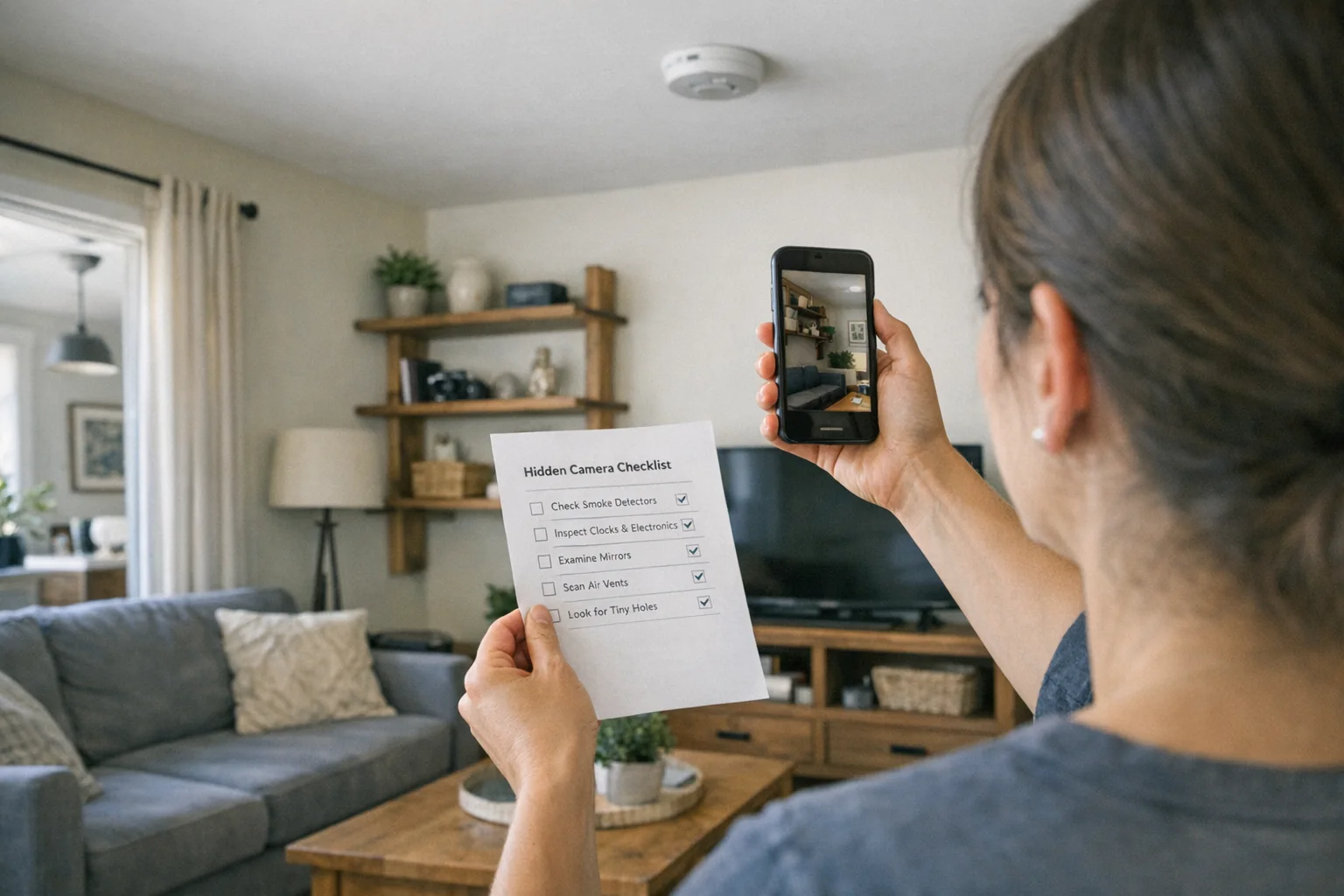
Best Hidden Camera Detector Apps (2026): iPhone & Android
The best hidden camera detector apps for iPhone and Android — what they find, what they miss, and when to upgrade to dedicated hardware.
Read guide