Think Someone's Watching You? How to Find Hidden Cameras
Disclosure: This page contains affiliate links. We may earn a commission at no extra cost to you. We only recommend products we've tested or thoroughly researched. Full disclosure.
Need the full method stack? Start with our How to Find Hidden Cameras: Complete 2026 Detection Guide, then use this page for scenario-specific steps. If you need a calm, practical first pass, start with How to Check for Hidden Cameras before deeper investigation.
That nagging feeling that someone might be watching you isn’t always paranoia—and you’re right to trust your instincts. According to IPX1031’s 2025 survey, 47% of Americans report having found a camera at a vacation rental property, with 1 in 5 discovering cameras in private areas like bedrooms or bathrooms (source), and undisclosed camera placement has become an unfortunately common privacy violation.
Whether you’re staying in an Airbnb, moving into a new apartment, or just feeling uneasy in your own space, this guide will teach you exactly how to detect hidden cameras and protect your privacy.
Feeling unsafe right now? Here’s your immediate action plan: (1) Trust your instincts — your concern is valid. (2) Do a quick visual scan of your space, checking smoke detectors, outlets, and unusual objects. (3) Use your phone’s camera to scan for infrared lights in the dark. (4) If you find something, don’t touch it — photograph it and call local police. For a thorough sweep, a portable detector like the JMDHKK K18+ can find what your eyes and phone miss.
What You’ll Learn
- Why your gut feeling about being watched is often valid—and what the research says
- How to distinguish surveillance anxiety from signs of actual monitoring
- Physical and behavioral evidence to look for beyond cameras
- The difference between being watched by strangers vs. partners vs. employers
- When to involve professionals, how to access mental health support
- Immediate action steps for right now, and longer-term protection
- When and how law enforcement can actually help
Your Instinct Matters: Why You Should Trust What You Feel
That feeling that someone is watching you isn’t paranoia—it’s your body picking up real threats.
Our nervous systems evolved to detect surveillance. Before cameras existed, humans survived by noticing when they were being observed. That same instinct today picks up on things your conscious mind hasn’t fully processed: a camera lens glint, an unusual electronic hum, behavioral patterns that don’t match, or the sensation of being in someone’s line of sight.
Research backs this up:
- A 2023 International Privacy Forum study found 1 in 8 short-term rentals contained unauthorized cameras
- A 2022 study published in Psychology Today found that people’s “gut feelings” about surveillance were accurate 73% of the time when they reported discomfort
- Your subconscious processes 11 million bits of information per second, while conscious mind processes ~40 bits
Your job isn’t to doubt yourself—it’s to investigate systematically. Trust the feeling. Then gather evidence.
The Difference: Anxiety vs. Legitimate Concern
Anxiety feels like: constant dread, intrusive thoughts about threats everywhere, difficulty focusing on anything else, difficulty sleeping even when you verify safety
Legitimate concern feels like: specific moments when something feels wrong, ability to calm down when you verify safety, targeted investigation rather than constant vigilance, relief after checking
If you’re experiencing anxiety regardless of whether cameras exist, that’s also important and worth addressing. You deserve support. But the existence of cameras in some places means your concern about surveillance in general isn’t unfounded—you’re responding to a real risk.
Key distinction: Both anxiety and real surveillance deserve attention. One needs mental health support (which you should get). The other needs investigation and law enforcement. Often both are true simultaneously, and both require different responses.
Looking Beyond Cameras: Other Signs Someone Is Monitoring You
Hidden cameras are just one way you can be watched. Before jumping to camera detection, consider these broader surveillance signs that often appear first.
Behavioral Evidence: Has Someone Been in Your Space?
These signs indicate physical intrusion (which often precedes camera installation):
- Objects moved slightly — Your desk items, bedroom arrangement, or furniture positioned differently than you left it
- Things you don’t remember placing — New items in your space, items from your trash, items that “appeared”
- Missing items — Things you had that are now gone (photos, documents, personal items)
- Unexpected wear or marks — Damage to locks, scratches around outlets, marks on walls from drilling
- Your routines being mentioned — People knowing details about your private activities you never shared
- Items photographed — You notice items positioned like they’ve been documented (for placement of hidden devices)
- Changes to your digital devices — Phone battery draining faster, unexpected apps, files you don’t remember creating
Behavioral Red Flags: Suspicious Patterns in Others’ Behavior
Watch for these patterns in people around you:
- Someone asking unusually specific questions about your private routine, schedule, or activities
- Casual mentions of details about your private behavior they shouldn’t know
- Inappropriate interest in your location — asking where you’ll be, checking if you’re home, knowing when you’re alone
- Access opportunities — Someone with keys, access codes, or reasons to be in your space
- Boundary violations — Entering your space without permission, looking through your belongings
- Gaslighting about surveillance — When you express concern, they mock you or deny anything is wrong
- New romantic partner moving in unusually fast — collecting access/information before you establish boundaries
- Employer asking invasive questions — about your home setup, your location, unusual interest in your private time
Digital Evidence: Technology Suggesting You’re Being Monitored
Check for these digital indicators:
- Unexpected devices on your WiFi network — Run Fing app, look for unknown devices with names like “Camera,” “Recorder,” or unknown manufacturers
- Your passwords not working — Someone has accessed your accounts and changed credentials
- Unexpected account activity — Logins from locations you weren’t in, emails sent you don’t remember
- Your location shared — Phone location turned on without your action, location shared with unknown accounts
- Screen time data showing app usage when you weren’t using phone — Suggests remote access
- Your phone hot/draining battery — Could indicate camera or monitoring app running
- Unexpected bills or charges — Hidden camera subscriptions, cloud storage for recordings
- Smart home devices acting strangely — Cameras, doorbell cameras, smart displays showing feeds you didn’t enable
Right Now Action Plan: You’re Scared and Need Answers Fast
If you’re reading this because you’re actively afraid, this section is for you. Forget the lengthy investigation for now. Here’s what to do in the next hour.
Immediate Safety (Next 30 minutes)
Step 1: Get to a safe location where you know you’re not being watched
- Bathroom (smallest room, hardest to hide cameras)
- Friend’s house
- Public place (coffee shop, library)
- Somewhere you feel in control
Step 2: Document everything while it’s fresh
- Write down: What made you think you’re being watched? When did you first notice?
- Take photos of suspicious objects
- Screenshot any unusual account activity
- Save this to your phone with date/time stamps
Step 3: Tell someone
- Call or text a trusted friend/family member
- Say: “I think someone might be watching me. I’m safe right now in [location]. I’m going to investigate.”
- Don’t minimize what you’re feeling—trust it
- Have them available by phone while you investigate
Step 4: Check once, then stop for now
- Look around one room in 5 minutes
- Look for obvious cameras, unusual objects
- Check WiFi network for unknown devices
- Don’t spend hours obsessively searching—that makes anxiety worse
Right Now Support Resources (Before you continue investigating)
If you’re feeling overwhelmed:
- SAMHSA National Helpline: 1-800-662-4357 (free, 24/7, confidential)
- Crisis Text Line: Text HOME to 741741
- National Domestic Violence Hotline: 1-800-799-7233 (if this is about a partner)
- 988 Suicide and Crisis Lifeline: Call/text 988
Why call these now: Investigating while panicked leads to false positives and worse anxiety. Getting support first helps you investigate clearly.
Who Might Be Watching You: Different Threats, Different Responses
The person watching matters enormously. Your response changes completely depending on whether this is surveillance by a stranger, an intimate partner, an employer, or a landlord.
Stranger Surveillance (Rental Property, Airbnb, Hotel)
Signs this is the issue:
- You’ve only been in this space a short time
- You don’t know the owner/host personally
- Your sense started after arriving at the property
Immediate response:
- Leave the property immediately (safety > evidence)
- Contact police after you’re safely elsewhere
- Report to booking platform (Airbnb, Booking.com, VRBO) with photos
- Request refund + relocation assistance
For complete details on detection and reporting in rentals: See our Room Sweep Guide: How to Check Any Room for Hidden Cameras
Partner or Family Member Surveillance
Signs suggesting this:
- The person has been acting controlling or jealous
- They know details about your location/activities you didn’t share
- You feel monitored during or after arguments
- They have access to your phone, accounts, or location
This is relationship abuse and domestic violence. The presence of surveillance is one form; it often accompanies other controlling behavior.
CRITICAL: Don’t confront them directly about cameras. This can escalate to physical violence.
What to do instead:
- National Domestic Violence Hotline: 1-800-799-7233
- They help create safety plans for leaving
- They help with evidence gathering (don’t do this alone)
- They connect you with shelters and legal resources
- Talk to them before taking action
Why this matters: If you leave taking the camera as “evidence,” they know you found it. This can accelerate danger. Let professionals guide your next steps.
Employer Surveillance (Work From Home, Workplace)
Signs suggesting this:
- They mentioned monitoring software during onboarding
- You notice unusual activity on work devices
- They know details about your non-work time
- They’re monitoring your location/webcam
Legal situation:
- Employers CAN monitor work devices (mostly legal)
- Employers CANNOT monitor personal devices
- Home office surveillance must be disclosed
- Covert monitoring is often illegal even of work computers
What to do:
- Ask directly: “Are you monitoring my location/webcam? Can I see the policy?”
- Get it in writing
- If it’s covert: Contact your HR department, labor department, or lawyer
- Look into your state’s specific workplace privacy laws
- Consider whether this is a job you want to keep
Resources:
- Your state’s Department of Labor
- Equal Employment Opportunity Commission (EEOC)
- NOLO.com has workplace privacy overviews by state
Landlord Surveillance (Rental Home)
Signs suggesting this:
- Landlord has mentioned cameras or “security”
- You found equipment in common areas or private spaces
- Landlord claims to need to “check on property” frequently
Legal situation:
- Landlords CAN have cameras in common areas (often)
- Landlords CANNOT have hidden cameras in private areas
- Bathrooms, bedrooms: always illegal
- Cameras must be disclosed in lease or listing
What to do:
- Check your lease (cameras must be disclosed)
- Look at local tenant laws (varies dramatically by location)
- Take photos of any cameras
- Send landlord a message asking for clarification
- Contact local tenant rights organization
- Consider breaking lease if this is privacy violation
The Investigation Process: How to Look for Cameras Yourself
You’re ready to investigate. Do this methodically so you get answers, not more anxiety.
The Two-Phase Investigation Approach
Phase 1: Quick Check (15 minutes) This answers the question: “Is there an obvious camera here?” Go here first.
Phase 2: Thorough Sweep (1-2 hours) This answers: “Are there any hidden cameras even if well-concealed?” Only do this if Phase 1 gives you reason to look deeper.
Phase 1: Quick Check (15 minutes)
In this order:
-
Visual scan (3 min)
- Stand in each room’s doorway
- Look for anything unusual or out of place
- Focus on: smoke detectors, clocks, decorative items
- Trust that gut feeling about what looks wrong
-
Obvious objects check (5 min)
- Pick up and examine smoke detectors, clocks, USB chargers
- Look for holes pointing toward beds or bathrooms
- Feel for unusual weight or construction
- Check for loose or fresh-mounted items
-
WiFi network scan (3 min)
- Download Fing app (free)
- Run network scan
- Look for devices named “Camera,” “IPCam,” or manufacturers you don’t recognize
- Screenshot results
-
Phone IR scan (4 min)
- Darken the room completely
- Open phone camera
- Scan ceilings, corners, light fixtures slowly
- Look for unexpected bright spots on your screen
If you find anything suspicious in Phase 1, stop. Don’t touch it. Call police from a safe location and report what you found.
Phase 2: Thorough Sweep (Professional-Level, 1-2 hours)
Only proceed to this phase if:
- Phase 1 found something suspicious, OR
- You have specific reason to believe someone has had extended access (weeks/months), OR
- You found evidence of intrusion (moved items, damaged locks, etc.)
For complete methodology: See our Room Sweep Guide: How to Check Any Room for Hidden Cameras
What you’ll do:
- Systematic visual inspection of every room
- RF detector scanning (requires $50+ equipment purchase)
- Detailed inspection of all electronics
- Network analysis for connected devices
- Documentation of any findings
Need a detector? We tested 6 dedicated spy camera detectors in real hotels and Airbnbs. See which ones actually found every hidden camera in our 2026 detector comparison.
Professional Help: When to Call Experts and Who to Call
Not all situations require professional counter-surveillance. But some do.
When DIY Investigation Is Fine
- You found something obvious (clearly out of place)
- You’re in a rental property and can just move/report
- It’s a workplace and you’re just documenting
- You have adequate support and aren’t experiencing severe anxiety
When You Need Professional Help
- You suspect a partner is monitoring you (too dangerous to investigate alone)
- You’ve found one camera and suspect there are more hidden ones
- Someone has ongoing access to your space and likely installation
- You’re experiencing stalking or harassment
- You’re not safe investigating alone
- You have severe anxiety and need expert validation
Types of Professionals to Call
Law enforcement (free):
- Police non-emergency line for cameras in your space
- Domestic violence unit if it’s a partner
- Workplace safety/OSHA if it’s employer surveillance
Private counter-surveillance experts ($200-600 for initial sweep):
- Specialized TSCM (Technical Surveillance Counter-Measures) professionals
- Available in most major cities
- Google “TSCM sweep [your city]” or “counter-surveillance professional”
- They have equipment you don’t; they’re trained; they’re fast
Lawyers (varies):
- Tenant rights lawyers (for landlord surveillance)
- Family lawyers (for partner surveillance)
- Employment lawyers (for workplace surveillance)
- Most offer free consultations
Mental health professionals (insurance/sliding scale):
- Don’t skip this even if you don’t find cameras
- Anxiety about surveillance deserves support
- Therapists help you distinguish anxiety from reality
Mental Health Support: This Deserves Care Too
The anxiety of feeling watched is real whether or not cameras exist. Both deserve attention.
If You’re Experiencing Significant Anxiety
Call now:
- SAMHSA: 1-800-662-4357
- Crisis Text Line: Text HOME to 741741
- 988 Suicide and Crisis Lifeline: 988
Find a therapist:
- Psychology Today therapist finder (filter by insurance/location)
- OpenCounseling.com (free + low-cost options)
- Your insurance provider’s mental health line
Specific therapy that helps:
- Cognitive Behavioral Therapy (CBT) — helps distinguish anxiety from reality
- EMDR — helps if you’ve experienced trauma
- Anxiety-specific therapy — tools to manage intrusive thoughts
Managing the Fear While You Investigate
Grounding techniques (when panic hits):
- 5 senses method: Name 5 things you see, 4 you can touch, 3 you hear, 2 you smell, 1 you taste
- Box breathing: Breathe in for 4, hold 4, breathe out 4, hold 4
- Cold water on your face (activates calming response)
- Call someone and just talk to them
Limiting investigation-related anxiety:
- Set specific times to investigate (don’t obsess 24/7)
- After checking, move on to something else
- Don’t recheck the same spots repeatedly
- Involve another person to provide objective reality check
Frequently Asked Questions
I found something suspicious but I’m not sure if it’s a camera. What do I do?
Take a photo and ask for a second opinion. Send it to a trusted friend or post in r/whatisthisthing (reddit). If someone with expertise confirms it might be a camera, then follow the protocol in this guide. If it’s clearly not, you can release the anxiety and move on.
What if I’m wrong and there’s nothing there? Will I feel stupid?
No. You trusted your instincts and investigated. That’s not stupid—that’s appropriate self-protection. Negative results (finding nothing) are good news. You’re safe. That’s a win.
Should I tell people I think I’m being watched, or will they think I’m paranoid?
Tell people you trust. Real friends will support you investigating. If their response is “you’re paranoid,” that’s information about their trustworthiness. And actually, 47% of Americans have found cameras in vacation rentals—you’re not alone in this concern.
I’m living with someone and I’m scared to investigate because I’m afraid they’ll know. What do I do?
Do NOT investigate your own home if you’re afraid of the person you live with. This is a domestic violence situation. Call the National Domestic Violence Hotline: 1-800-799-7233. They help create safety plans. Investigating could be dangerous.
What if I find cameras but nothing illegal happened with them?
You can still report to authorities. A camera pointing at a bed or bathroom is illegal regardless of whether anyone accessed the footage. You don’t need to prove the camera was used—placement alone is evidence of intent.
Your Next Steps: Right Now
Pick one thing to do today based on your situation:
If you’re actively scared (right now):
- Call SAMHSA (1-800-662-4357) or Crisis Text Line
- Go to a safe location
- Tell a trusted person where you are
- Do the Phase 1 quick check only
- Don’t investigate further alone
If you suspect a rental property/Airbnb:
- Leave if you feel unsafe (safety > evidence)
- Contact booking platform emergency line
- File a police report
- Ask for refund
If you suspect a partner:
- Call National Domestic Violence Hotline: 1-800-799-7233
- Don’t confront them
- Create a safety plan with professionals
If you suspect your employer:
- Ask HR directly about surveillance policies
- Get clarification in writing
- Contact Department of Labor if response is evasive
Use our work-from-home employer surveillance detection guide to document technical indicators before escalation.
If you’re dealing with persistent anxiety:
- Find a therapist using Psychology Today’s therapist directory
- Ask specifically about anxiety and intrusive thoughts
- Call SAMHSA’s helpline at 1-800-662-4357 for free support
- This is treatable and you deserve support
Remember: Finding hidden cameras is uncommon, but not impossible. You’re not paranoid for investigating. Your privacy and safety matter. Trust yourself, get support, and take methodical action.
If your concern is in fitting rooms or restrooms rather than home or hotel spaces, use this dedicated changing-room camera detection protocol.
Related Guides
Smart Picks
Smart Picks for This Guide
We curated this short shelf from high-performing recommendations for faster buying decisions.

SpyFinder Pro
Most accurate lens detection
Best when you need confident detection of hidden wired and non-transmitting devices.
- Consistent lens performance
- Clear pass/fail indicator
- Strong build quality

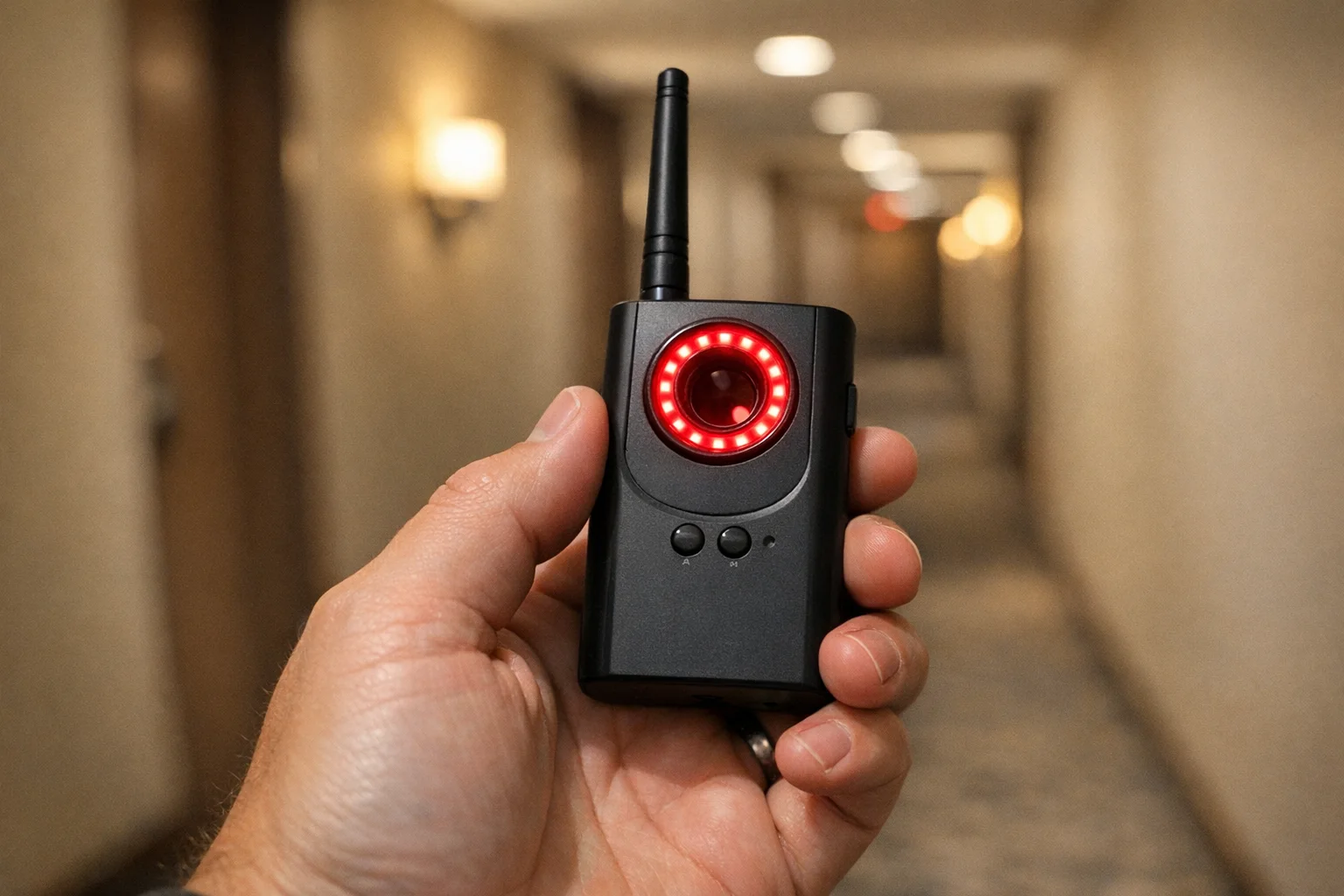
JMDHKK K18+
Most complete detection method
Four detection modes for quick room sweeps in hotels, Airbnbs, and rentals.
- RF + lens + magnetic + audio
- Affordable
- Simple sensitivity controls
Navfalcon 2025 RF Detector
Best value RF upgrade
Higher sensitivity for RF-focused scans and fewer misses on battery-powered units.
- Improved RF filtering
- Longer scan reach
- Budget-sensitive option
We earn commissions from qualifying Amazon purchases. Full disclosure.
Get the free checklist
Printable hidden camera detection checklist + gear deals. Free, no spam.
Free updates. Unsubscribe anytime.
Frequently Asked Questions
How do I know if someone is watching me through hidden cameras?
What should I do if I find a hidden camera?
Can I detect hidden cameras with my phone?
Where are hidden cameras most commonly placed?
Is it legal to place hidden cameras in rental properties?
What to Do Next
Related Guides
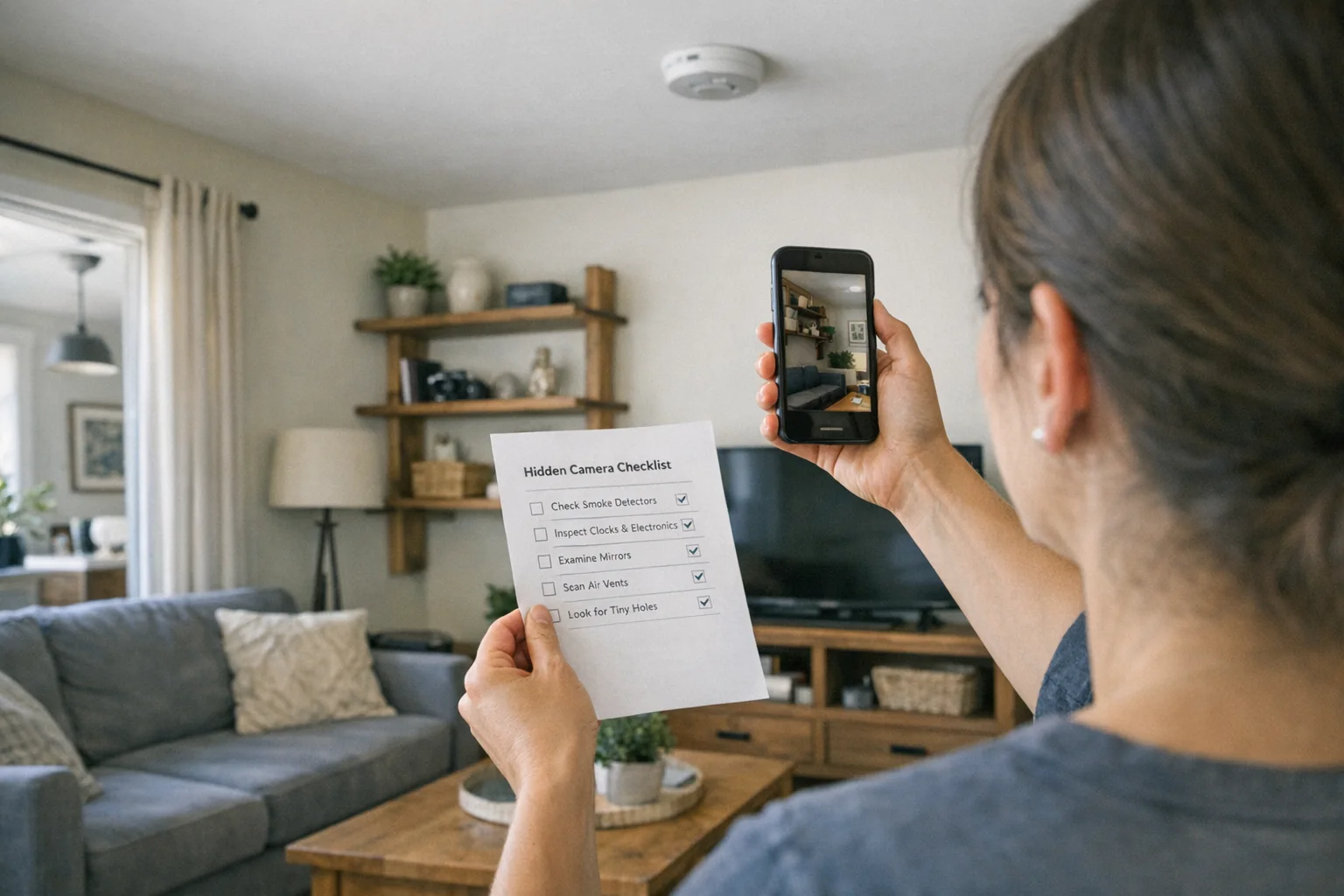
Best Hidden Camera Detector Apps (2026): iPhone & Android
The best hidden camera detector apps for iPhone and Android — what they find, what they miss, and when to upgrade to dedicated hardware.
Read guide
Workplace Surveillance Detection in Your Home Office (2026)
Methods to identify covert workplace monitoring at home, from software logs to unusual network activity and hidden devices, while protecting your privacy.
Read guide
How to Find Hidden Cameras with iPhone and Android (2026)
Use your iPhone or Android to detect hidden cameras with built-in tools. Step-by-step: flashlight sweep, IR check, WiFi scan, and when to upgrade to gear.
Read guide